

Veev la Revo-loo-syon!
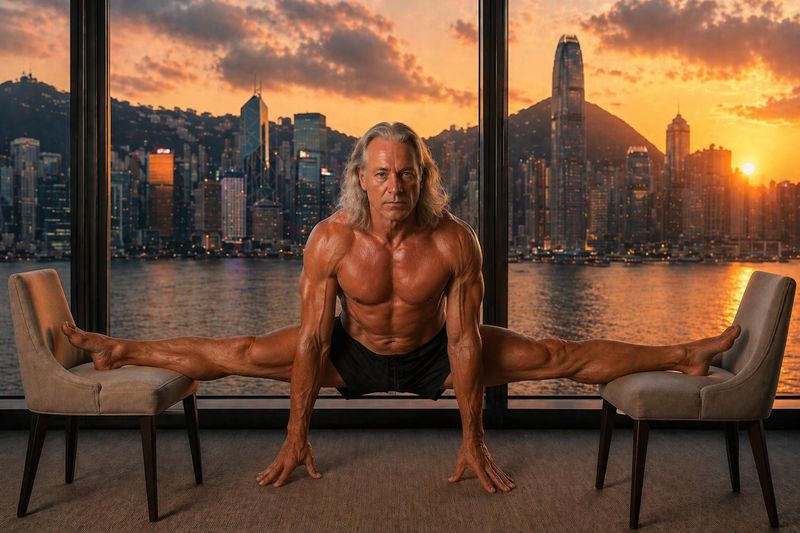
The sun burned high above the dusty film set as Jeanclaude van Damned held his iconic split between two director’s chairs, completely unfazed, completely shirtless. Every single muscle in his body shimmered with purpose, like marble carved by impatient gods. Crew members paused—not because they hadn’t seen it before, but because it still made reality feel slightly optional.
“Jeanclaude, we need one more take!” the director shouted.
“Ah, oui-oui, of courrse,” Jeanclaude replied smoothly. “Perfection… she is not a desteenation. She is… ’ow you say… a laeef-style, yesss?”
Suddenly, his watch pulsed—low, mechanical, almost alive. Not just a beep, but a warning.
Jeanclaude slowly lifted his wrist.
“Mon deeeu… zee timeleeeen…”
A thin line appeared in the air in front of him—at first like a crack in glass, then widening. It shimmered unnaturally, as if space itself had been sliced open. Inside: swirling light, fragments of moments, echoes of voices from other centuries. This was no metaphor. This was a tear—a literal rupture in time, where past, present, and possibility leaked into one another.
His watch projected the alert: Paris, 1789. Revolution compromised.
Jeanclaude inhaled slowly. Then, with practiced discretion, he reached into a small silver case for a quick, almost ceremonial focus boost.
“Ahh… now we are… ’ow you say… concentré,” he murmured, eyes sharpening instantly.
“Zis eez trèèès catastrophique. Weethout zee révolution… no liberté… no baguette… no moi.”
The tear widened, humming softly, pulling at the edges of reality.
Jeanclaude rolled his shoulders, exhaled… then leapt—spinning into a perfect mid-air split—straight into the glowing fracture.
Paris exploded around him.
Smoke, shouting, steel, fear. The Bastille towered ahead, but something was off—the crowd hesitated, uncertain, as if courage itself had been edited out of the moment. Jeanclaude landed in a flawless split atop a broken cart.
“Seetoyennn!” he called out. “Pour-quoi you are so… ’esitat-eeng, hmm?”
A man stared. “Who are you?!”
Jeanclaude rose slowly, every muscle catching firelight and revolution alike.
“I am… ’ow you say… a freeeend of zee fyootoorrr. And you— you must attack zee Basteeeel! Weeth paassion! Weeth styyyyle!”
Guards rushed forward. Jeanclaude sighed.
“Ahhh… zey insist.” Then—movement.
A blur of kicks, spins, impossible flexibility. His body flowed like time itself—unstoppable, precise. A musket flew from a soldier’s hands.
“Non-non-non! You aim like a sleeeepy croa-ssaaant!” Jeanclaude snapped. “Regard—like zeeees!” He launched into an airborne split-kick—two guards down in one motion. The crowd began to roar again. Momentum returned. History corrected itself.
“Vive la Révolution!”
Jeanclaude placed a hand dramatically on his chest.
“Veev… la revo-loo-syon… and also… zee peeerfect timing, hmm?”
With one final strike, the gates gave way.
Moments later, the tear reopened—like a wound stitching itself shut.
Jeanclaude stepped through.
Back on set.
“Jeanclaude! Where were you?!” the director yelled.
He casually dropped back into his split between the chairs.
“Me?” he smiled. “I was just… ’ow you say… strech-eeng zee realiteee.”
“Camera rolling!”
Jeanclaude winked.
“Aaand… ac-shee-on.”